Articles & Guides
Beyond Checkbox Quality: Two Leaders on Business Continuity, CAPAs, and Collaboration
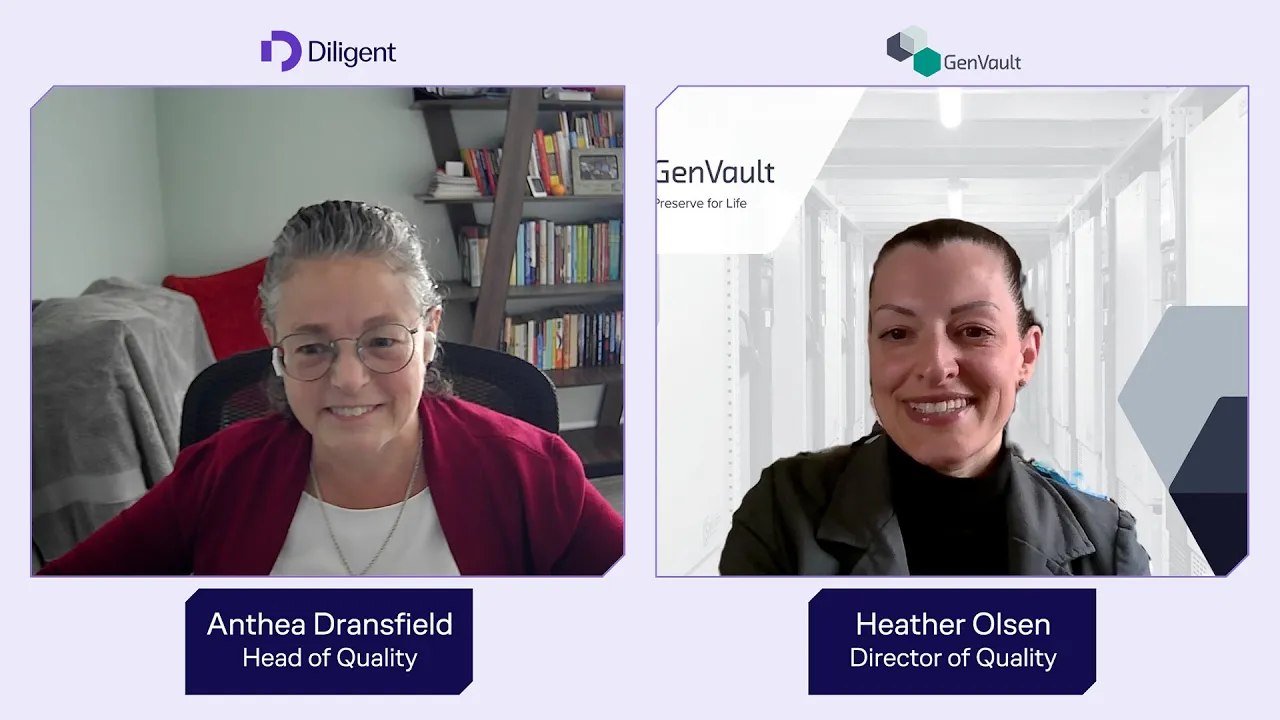
In celebration of International Quality Month, two quality leaders sat down for an honest conversation about the real work and stories behind business continuity, risk mitigation, and CAPA. What unfolded was a candid discussion about the gaps, misconceptions, and human elements that define quality work in clinical trials.
Anthea Dransfield, Head of Quality at Diligent Pharma, brings over 32 years of experience across both operations and quality in the pharmaceutical industry. Heather Olsen, Director of Quality and Compliance at GenVault, has spent more than 25 years in quality across food manufacturing, drug packaging, and biorepository management.
What emerged were three practices quality teams can develop to increase their effectiveness and refocus their time on what matters most. You can watch the full discussion here and read the key takeaways below.
Business Continuity: Testing Plans Should Be A Living Practice, Not Just a Document on a Shelf
Business continuity planning often starts and stops with documentation. Companies perform risk assessments, identify organizational risks, document backup systems and response plans, and then file everything away until an audit requires proof of compliance. Both quality leaders emphasized that this approach misses the point.
"Everyone needs to understand their roles and responsibilities. So training is very important, and not just training, but practicing those drills and response plans with your employees." Heather explained. "[Practicing in a way that] everyone understands the why behind what you're doing and how to accomplish it... So it's really important to have those scheduled drills every six months, every quarter, depending on what the activity is, so everyone's ready to go any moment if something should fail or go wrong."
Testing makes a difference as technology changes rapidly and the risk landscape evolves. Anthea pointed out that mock scenarios help teams identify weaknesses before real failures occur. Regular drills keep teams prepared, so they're not scrambling to remember a rarely used protocol during a crisis. And understanding the why behind response plans enables teams to adapt when a situation doesn’t unfold exactly as practiced.
CAPA: When You Need It and When You Don't
The frustration around CAPA overload was clear. When every audit observation becomes a CAPA, and every minor finding triggers a full investigation, the system creates noise rather than improvement.
A common pattern emerges: something is forgotten or flagged as a potential risk, and there’s an immediate pressure to implement a CAPA that changes the entire process. But one-off outlier events don’t necessarily indicate wider systemic problems. Sometimes all that’s needed is a documented correction, and in those cases, it’s best to figure out what happened, what must be done to fix it, and determine the best next steps to move forward.
This said, cumulative minor findings could indicate a more complex underlying issue. When lots of smaller findings start adding up and patterns emerge across different areas or time periods, the situation might benefit from thorough investigation and structured CAPA.
The challenge lies in distinguishing deeper problems from isolated events. A correction addresses the immediate problem. A CAPA investigates systemic root causes and implements preventive actions.
Root Cause Analysis: If the Answer Is Always "More Training," You Probably Haven't Found the Root Cause
When something goes wrong, the explanation that surfaces is often related to training. It's a natural starting point, but both leaders emphasized that effective root cause analysis requires digging deeper to find what actually caused the problem.
Anthea recounted a situation at a clinical research unit where although the team’s immediate reaction pointed to training, she identified a potential underlying issue and took a different approach:
"We got the sticky notes out and we actually process mapped what should have happened and then what did happen using different colored sticky notes for the pieces that didn't go according to plan. Then we were able to use root cause analysis tools, things like the Five Whys, Ishikawa diagram, maybe even a FMEA (Failure Mode and Effects Analysis) to be able to dive deeper. And it came out that training wasn't the problem at all."
The real problem? A process had changed, but that change hadn't been communicated to all the teams who needed to follow the slightly different approach. They had an updated protocol, but teams weren’t able to follow it because they didn't know it existed. Communication was the issue, not training.
Heather shared a parallel experience around documentation practices. Different departments handled third-party paperwork inconsistently, with signatures and reviews missing or incomplete. Multiple minor findings accumulated into a bigger pattern. The initial assumption pointed toward documentation training, but deeper investigation revealed something else. The teams lacked real-world examples and context of how to handle various scenarios.
The solution therefore required bringing everyone together for a group discussion where people opened up with questions and chatted through potential real-life scenarios. Discussing these examples in a group setting helped provide context to the processes and close gaps that written procedures alone wouldn’t address.
Heather noted the importance of getting feedback from the people who perform the work to help develop processes they can actually follow. "They feel like they had a part of that development and ... they're more likely to follow the processes that they had a buy-in to develop," she explained.
Moving Forward
Conversations like this matter because they surface the gap between how quality is often practiced and how it could work more effectively. External pressures, audit expectations, and historical practices create momentum that's hard to redirect, but the solutions aren't complicated. New habits build a stronger culture of quality: Regular drills and practice for business continuity. Distinguishing between corrections and true CAPAs. Asking "why" enough time to find root causes. Writing procedures at the right level for the people who use them. Building feedback loops and effectiveness checks into every change.
Quality works best when it serves the people doing the work, when it helps set teams up for success rather than documenting their failures. That shift in perspective, from enforcement to enablement, creates the culture needed for continuous improvement.
Watch the full conversation above to hear more insights from Anthea and Heather on navigating quality challenges in clinical trials.
Start your next trial faster with higher quality and compliance.
Our team is ready to support your unique needs. Schedule a demo today.